 |
|
Operation Plumbbob - 1957
|

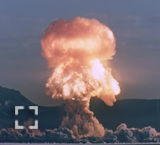
Hood - 05/07/1957
|
Operation Plumbbob was a series of nuclear tests conducted between May 28, and October 7 1957 at the Nevada Test Site (NTS). It was the biggest, longest, and most controversial test series conducted in the continental United States. The LASL shots were named after deceased scientists, the UCRL shots were named after North American mountains.
Operation Plumbbob consisted of 29 explosions, of which two did not produce any nuclear yield. 21 laboratories and government agencies were involved. While most Operation Plumbbob tests contributed to the development of warheads for intercontinental and intermediate range missiles, they also tested air defense and anti-submarine warheads with small yields. They included 43 military effects tests on civil and military structures, radiation and biomedical studies, and aircraft structural tests. Operation Plumbbob had the tallest tower tests to date in the U.S. nuclear testing program, as well as high-altitude balloon tests.
1,200 pigs were subjected to biomedical experiments and blast-effects studies during Operation Plumbbob. On shot Priscilla (37 KT), 719 pigs were used in various different experiments on Frenchman Flat. Some pigs were placed in elevated cages and provided with suits made of different materials, to test which materials proved the best protection from the thermal pulse. Other pigs were placed in pens at measured distances from the epicenter behind large sheets of glass to test the effects of flying debris on living targets.
Approximately 18,000 members of the U.S. Air Force, Army, Navy and Marines participated in exercises Desert Rock VII and VIII during Operation Plumbbob. The military was interested in knowing how the average foot-soldier would stand up, physically and psychologically, to the rigors of the tactical nuclear battlefield.
Studies were conducted on radiation contamination and fallout from a simulated accidental detonation of a weapon; and projects concerning earth motion, blast loading and neutron output were carried out.
Nuclear weapons safety experiments were conducted to study the possibility of a nuclear weapon detonation during an accident. On July 26, 1957, a safety experiment, "Pascal-A" was detonated in an unstemmed hole at NTS, becoming the first underground shaft nuclear test. The knowledge gained here would provide data to prevent nuclear yields in case of accidental detonations, such as a plane crash.
Notable Tests
Owens - 25/07/1957
|
Experiments were conducted during shots Boltzmann and Franklin into the 'Rope Trick' effect, a continuation of the research done by Dr. John Malik during Operation Plumbbob in 1952. Revealed by high-speed and rapatronic photography, spikes can be observed extending out from the early fireball caused by the incineration of tower mooring cables. For Boltzmann, a box containing 9.5 tons of sand was placed to the right of the bomb, and a 15.5 ton paraffin shield was placed on the floor of the shot cab to protect the instrumentation.
Hood -
At 74Kt, Hood was the largest atmospheric test ever conducted in the continental U.S.
Priscilla and Owens -
These shots exhibited the same double fireball phenomenon seen first earlier during shot Grable of Operation Upshot-Knothole. Images of Grable were accidentally relabeled as belonging to Priscilla. As a consequence published material including official government documents were incorrect . The shots can be distinguished by the trails of test rockets, which are prominently featured in images and footage of Grable, but appear almost completely absent at the actual Priscilla shot.
Smokey -
Had the highest yield to weight ratio of any known weapon (about 6 kt/Kg). Smokey became notorious due to the radiation exposures received by over three thousand servicemen who were brought in as part of the Desert Rock exercises to conduct maneuvers in the vicinity of ground zero shortly after the test.
Rainier -
The first fully contained underground nuclear test, meaning that no fission products were vented into the atmosphere. This 1.7 kiloton test could be detected around the world by seismologists using ordinary seismic instruments. The Rainier test became the prototype for larger and more powerful underground tests.
Pascal-B -
A 900 kg steel plate cap was blasted off the top of a test shaft at an unknown speed. The test's experimental designer Dr. Brownlee had performed a highly approximate calculation that suggested that the nuclear explosion, combined with the specific design of the shaft, would accelerate the plate to six times escape velocity. The plate was never found, but Dr. Brownlee believes that the plate never left the atmosphere, possibly vaporized by compression heating of the atmosphere. The calculated velocity was sufficiently interesting that the crew trained a high-speed camera on the plate, which unfortunately only appeared in one frame, but this nevertheless gave a very high lower boundary for the speed. After the event, Dr. Robert R. Brownlee described the best estimate of the cover's speed from the photographic evidence as "going like a bat!". This incident was reputedly used as part of the technical justification for the Orion project for possible use of nuclear blasts for outer-space propulsion.
John -
A proof test of the unguided Genie nuclear air-to-air rocket, fired from a F-89J Scorpion interceptor by USAF Captain Eric William Hutchison. A group of five USAF officers volunteered to stand uncovered in their light summer uniforms approximately three kilometers beneath the 2Kt blast to prove that the weapon was safe in a public relations exercise. A reel-to-reel tape recorder was present to record their experience. The placard reading "Ground Zero; Population Five" was made by Colonel Arthur B. "Barney" Oldfield, the Public Information Officer for the Continental Air Defense Command who arranged for the volunteers to participate.
The five volunteers were: Colonel Sidney Bruce, Lt. Colonel Frank P. Ball, Major Norman "Bodie" Bodinger, Major John Hughes, Don Lutrel, and the cameraman George Yoshitake (who didn't volunteer).
|
- Click on a thumbnail for a larger version
|
Test Shots
| Video |
Name |
Yield |
Date |UTC| |
Type |
Warhead |
Location |
LAT/LONG |
 |
Bolzmann |
12 Kt |
11:55 28/05/1957 |
Tower @150m |
XW-40 |
NTS Area 7c |
37.09470 -116.02360 |
| - |
Franklin |
0.14 Kt |
11:55 02/06/1957 |
Tower @90m |
XW-30 |
NTS Area 3 |
37.04780 -116.02110 |
| - |
Lassen |
0.6 Kt |
11:45 05/06/1957 |
Baloon @150m |
- |
NTS Area 9a |
37.13470 -116.04080 |
| - |
Wilson |
10 Kt |
11:45 18/06/1957 |
Baloon @150m |
XW-45x1 |
NTS Area 9a |
37.13470 -116.04080 |
|
|
Priscilla |
37 Kt |
13:30 24/06/1957 |
Baloon @210m |
TX-15/39 |
NTS Area 5 |
36.79810 -115.92890 |
| - |
Coulomb-A |
0 Kt |
17:30 01/07/1957 |
Surface @0m |
XW-31 |
NTS Area 3h |
37.04000 -116.03000 |
|
|
Hood |
74 Kt |
11:40 05/07/1957 |
Baloon @460m |
- |
NTS Area 9a |
37.13470 -116.04080 |
|
Diablo |
17 Kt |
11:30 15/07/1957 |
Tower @150m |
- |
NTS Area 2b |
37.15030 -116.10860 |
|
John |
1.7 Kt |
14:00 19/07/1957 |
AA Rocket @9140m |
W-25 |
NTS Area 10 |
37.16060 -116.05310 |
|
Kepler |
10 Kt |
11:50 24/07/1957 |
Tower @150m |
XW-35 |
NTS Area 4 |
37.09500 -116.10300 |
|
Owens |
9.7 Kt |
13:29 25/07/1957 |
Baloon @150m |
XW-51 |
NTS Area 9b |
37.13470 -116.04080 |
| - |
Pascal-A |
0.01 Kt |
08:00 26/07/1957 |
Subsurface @150m |
- |
NTS Area 3j |
37.05180 -116.03340 |
|
Stokes |
19 Kt |
12:25 07/08/1957 |
Tower @150m |
XW-30 |
NTS Area 1 |
37.05310 -116.10250 |
| - |
Saturn |
0 Kt |
01:00 10/08/1957 |
Tunnel @-39m |
XW-45x1 |
NTS Area 12c |
37.19390 -116.03330 |
| - |
Shasta |
17 Kt |
12:00 18/08/1957 |
Tower @150m |
- |
NTS Area 2a |
37.12800 -116.10640 |
| - |
Doppler |
11 Kt |
12:30 23/08/1957 |
Baloon @460m |
XW-34 |
NTS Area 7b |
37.08670 -116.02360 |
| - |
Pascal-B |
0.01 Kt |
22:35 27/08/1957 |
Shaft @-150m |
- |
NTS Area 3c |
37.04910 -116.03400 |
| - |
Franklin Prime |
4.7 Kt |
12:40 30/08/1957 |
Baloon @230m |
XW-30 |
NTS Area 7b |
37.08670 -116.02360 |
|
Smoky |
44 Kt |
12:30 31/08/1957 |
Tower @210m |
TX-41 |
NTS Area 2c |
37.18720 -116.06780 |
|
Galileo |
11 Kt |
12:40 02/09/1957 |
Tower @150m |
|
NTS Area 1 |
37.05310 -116.10250 |
| - |
Wheeler |
0.2 Kt |
12:45 06/09/1957 |
Baloon @150m |
XW-51 |
NTS Area 9a |
37.13470 -116.04080 |
|
|
Coulomb-B |
0.3 Kt |
20:50 06/09/1957 |
Surface @0m |
XW-31 |
NTS Area 3g |
37.04300 -116.02600 |
| - |
Laplace |
1 Kt |
13:00 08/09/1957 |
Baloon @230m |
- |
NTS Area 7b |
37.08670 -116.02360 |
|
Fizeau |
11 Kt |
16:45 14/09/1957 |
Tower @150m |
XW-34 |
NTS Area 3b |
37.03360 -116.03140 |
|
Newton |
12 Kt |
12:50 16/09/1957 |
Baloon @460m |
XW-31 |
NTS Area 7a |
37.08670 -116.02360 |
| - |
Rainier |
1.7 Kt |
16:59 19/09/1957 |
Tunnel @272m |
W-25 |
NTS Area 12b |
37.19580 -116.20310 |
|
Whitney |
19 Kt |
12:30 23/09/1957 |
Tower @150m |
XW-27 |
NTS Area 2 |
37.13830 -116.11750 |
|
Charleston |
12 Kt |
13:00 28/09/1957 |
Baloon @460m |
- |
NTS Area 9 |
37.03360 -116.03140 |
| - |
Morgan |
8 Kt |
13:00 07/10/1957 |
Baloon @150m |
XW-51x1 |
NTS Area 9 |
37.13470 -116.04080 |

| - DNA 6001F - Defense Nuclear Agency report - Plumbbob - Galileo
|
|
| - DNA 6002F - Defense Nuclear Agency report - Plumbbob - Hood
|
|
| - DNA 6003F - Defense Nuclear Agency report - Plumbbob - Priscilla
|
|
| - DNA 6004F - Defense Nuclear Agency report - Plumbbob - Smokey
|
|
| - DNA 6005F - Defense Nuclear Agency report - Plumbbob
|
|
| - DNA 6006F - Defense Nuclear Agency report - Plumbbob - Diablo to Franklin Prime
|
|
| - DNA 6007F - Defense Nuclear Agency report - Plumbbob - Wheeler to Morgan
|
|
| - DNA 6008F - Defense Nuclear Agency report - Plumbbob - Bolzman to Wilson
|
|
|
|
|