 |
|
Welcome to Sonicbomb - An Illustrated History of Nuclear Weapons
Despite the end of the Cold War, nuclear weapons are by no means obsolete, still having a powerful effect on international politics and strategic stability to this day. Much of the history of nuclear weapons still remains classified by the governments that developed them. The following pages explore the nuclear weapons programs of the USA, Russia, Britain, France and China. Between 1945 and 1963, almost all nuclear testing was conducted in the atmosphere, until the Partial Test Ban Treaty of 1963 banned atmospheric testing. Despite this France and China continued to test in the atmosphere well into the 1970s and 1980s. Almost half of the nuclear weapons ever detonated were by the United States.
The peak number of global nuclear weapons reached 70,000 in 1986, and non-proliferation treaties and arms control agreements have dramatically decreased this number since. According to the Federation of American Scientists, as of 2025 there are approximately 12,331 nuclear warheads globally, with around 9,604 in military stockpiles, and 3,904 deployed with operational forces. Roughly 2,100 warheads are on high alert, ready for use on short notice, primarily by the US, Russia, UK, and France.
|
|
| USA |
 |
Program History
|
Operation History
|
Testing Database
|
Image Gallery
|
Weapons |
|
Program History
|
Operation History
|
Testing Database
|
Image Gallery
|
Weapons |
The US was the first country to test a nuclear weapon, and the first and only to use one in war. The US conducted most of its nuclear tests at the Nevada Test Site (NTS) and on Pacific islands, Bikini, Eniwetok, Johnston, and Christmas islands/atolls. Tests were conducted in groups known as 'operations' or 'test series' which involved large numbers of personnel, and often had a clear set of objectives. Since July 1962, all nuclear tests conducted in the US have been underground, and most of them have been at the NTS. The motivation for atmospheric testing was often a form of political 'sabe-rattling' as much as actual weapons development.
|
| USSR |
 |
Program History |
Testing Database |
Image Gallery
|
Weapons |
|
Program History |
Testing Database |
Image Gallery
|
Weapons |
The Soviet Union became the second nation in the world to detonate a nuclear device on 29/8/1949, and was responsible for the largest ever test with the 50 Mt Tsar Bomb in 1961. Nuclear tests were conducted at two main locations: the Semipalantinsk Test Site in Kazakhstan, and the Northern Test Site at Novaya Zemlya. Like the US, the USSR detonated a large number of underground tests or PNEs (peaceful nuclear explosions) under the premise that these explosions could be used for non-military purposes. This proved to have little value other than creating large highly radioactive holes in the ground. The test ID "RDS" refers to the weapon type, and "Joe" was the name given by the US and loosely equates to the sequential shot number.
|
| UK |
 |
Program History |
Testing Database |
Image Gallery
|
Weapons |
|
Program History |
Testing Database |
Image Gallery
|
Weapons |
Britain conducted its first test codenamed Hurricane, on the Monte Bello Islands just off the west coast of Australia aboard the HMS Plym in 1952. After the witnessing the US Castle tests in 1954, it became clear to the British government that if the UK was to retain its superpower status it would need to develop its own H-bomb. This led to the Grapple test series in 1957 at Malden Island in the Pacific. Under almost insurmountable post World War II budget and time constraints, successful designs were tested and deployed. This proved to the world and more importantly to the US that Britain was capable of producing an H-bomb. The US then amended its legislation, and the exchange of information between the US and Britain resumed. Subsequently British designs were abandoned in favour of US weapons due to both financial and political reasons.
|
| France |
 |
Program History |
Testing Database |
Image Gallery
|
Weapons |
|
Program History |
Testing Database |
Image Gallery
|
Weapons |
The first French nuclear Gerboise Bleue, was detonated in February 1960 at Reggane in Algeria. This device had a notably high yield of 60-70 kt, larger than other nuclear powers had detonated for their first tests. Testing in Algeria continued until 1966 when France's testing program moved to the Mururoa and Fangataufa Atolls in the South Pacific. France's efforts to develop thermonuclear weapons came to fruition in 1968 with the Canopus test over Fangataufa. Although most nations ceased atmospheric testing in the early sixties, France continued atmospheric testing well into to the mid-seventies, and underground testing as recently as 1996, despite heavy protests.
|
| PRC |
 |
Program History |
Testing Database |
Image Gallery
|
Weapons |
|
Program History |
Testing Database |
Image Gallery
|
Weapons |
Over the years, China invested relatively few resources in developing nuclear weapons compared to either the U.S. or Russia, and conducted less than 5% of the combined tests by these two countries. As with many atomic nations, the exact size and composition of its nuclear forces and testing program are difficult to determine due to strict secrecy. With the conclusion of Chinese testing in 1996, they had completed the development of a range of warheads similar to the state-of-the-art weapons developed by the other nuclear powers. China's one test site is the Lop Nor salt basin in the Xinjiang Uygur Autonomous Region. This world's largest test site occupies 100,000 sq km. Lop Nor contains four testing zones : three for underground testing and one for atmospheric.
|
| US DOE Films |
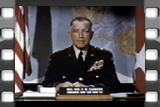 During the U.S atmospheric testing period between 1945 and 1962, films were produced Los Alamos and a top secret film unit known as Lookout Mountain Laboratory based in Hollywood. These classified films were for the military brass, technical analysis, and training. In the decades since thousands of these films decomposed in high-security vaults. Between 1997 and 2000 the U.S DOE transferred these historically significant declassified films to VHS, making them available to the public. In 2007 more restoration work was conducted by the Lawrence Livermore National Laboratory with around 4,200 films being scanned, of which many have been declassified. The goal was to preserve the films content, providing better post-testing era data. Many of the films experienced heavy degradation during the years of storage. Significant restoration work has been conducted by Atomcentral using their award winning patented photochemical restoration process (Showreel).
|
| Weapon Effects |
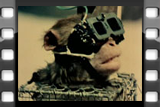 As important as the weapon itself, a significant portion of each operation was dedicated to gathering data on the effects of the detonation on materials, vehicles, structures and animals. This testing was used to both improve weapon design and increase their effectiveness. Studies were done to increase understanding of the ability to survive a nuclear attack. But with the advent of high yield thermonuclear weapons in the early 1950s, it became apparent a that there was little chance of the general public surviving a large exchange. A number of non-nuclear conventional explosive tests were conducted by the U.S and Soviets to produce relevant weapon effects studies without the expenditure of fissionable material.
|
| Information Films |
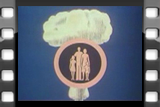 The U.S. monopoly on nuclear weapons was broken in 1949 when the Soviet Union tested its first nuclear device, and the government realised that public fears about the possibility of nuclear war required addressing. Documentary films were commissioned to sell the concept to the public of a survivable nuclear war. Both the U.S. and Soviet military realised that an all-out strategic war was inconceivable; the concept of limited, tactical nuclear engagements with relatively low-yield weapons became an important concept both politically and in justifying further weapons development.
|
|
|
|
|