 |
|
UK Nuclear Weapons
|
Blue Danube
|
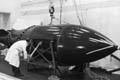 | Date:1953-62 | ~Prod.:58 | Mass:4.5 tons | Case:7.3m x 1.5m | Type:Fission | Yield:15kt |
The first operational British nuclear weapon, developed as a free-fall atomic bomb for the Royal Air Force, conceived under Operational Requirement OR.1001. It served as the primary strategic nuclear armament for the UK’s V-bomber force (the Valiant, Vulcan, and Victor). It used an unboosted implosion core, tested during Operation Hurricane in 1952, and shots Marcoo and Kite of Operation Buffalo in 1956. Replaced by smaller tactical nuclear weapons like the Red Beard. Blue Danube added a ballistic casing to the existing Hurricane physics package, with four flip-out fins to ensure stablity. The first weapon was delivered to stockpile at RAF Wittering in November 1953. Bomb storage facilities were at RAF Barnham and RAF Faldingworth.
|
|
Violet Club
|
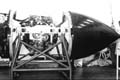 | Date:1953-62 | ~Prod.:58 | Mass:4.5 tons | Case:7.3m x 1.5m | Type:Fission | Yield:15kt |
Britain's first operational "high-yield" weapon and was intended to provide an emergency capability until a thermonuclear weapon could be developed from the 1956–1958 Operation Grapple tests. It used the high-yield pure-fission nuclear Green Grass warhead. Violet Club was replaced in service by the Red Snow warhead. This highly unsafe and logistically difficult weapon was deployed close to large population centers despite the inherent danger. |Green Grass arming|
|
|
Green Grass
|
 | Date:1950-56 | Prod.: □ | Mass: □ | Case: □ | Type:Fission | Yield:400kt |
Interim unboosted pure fission warhead based on the Orange Herald device tested at Grapple, with some of the implosion and firing features of Green Bamboo. The modulated neutron initiator was Blue Stone. Initially deployed in older casings derived from the Blue Danube known as 'Violet Club'. The Green Grass warhead was never tested. A massive unboosted pure fission device, it produced a high yield without fusion with an immense amount of Highly Enriched Uranium (HEU), estimated between 70-86kg, significantly more than a single uncompressed critical mass. It was kept subcritical by being fashioned into a thin-walled spherical shell. To guard against accidental criticality, the core was filled with 133,000 (450kg) steel ball-bearings, which required removal to arm the weapon.
|
|
Green Bamboo
|
| Date:mid-1950 | Prod.: □ | Mass: □ | Case: □ | Type:Fission | Yield:~1Mt |
'Layer-cake' type boosted fission weapon, similar to the Soviet RDS-6s and U.S. 'Alarm Clock' projects. It utilised layers of U-235 alternating with lithium deuteride fusion fuel and a complex 72-point implosion system. Designed to achieve a 1Mt yield. It was highly inefficient and required an immense amount of fissile material, specifically 87kg of U-235 making it very expensive to produce in numbers. The warhead had a 110cm diameter, dictated by the fuselage diameter of both the Yellow Sun free-fall bomb casing and the Blue Steel missile. Green Bamboo was kept strictly as a backup option and was never deployed or tested.
|
|
Green Cheese
|
| Date:1950-56 | Prod.: □ | Mass:1.7 tons | Case: □ | Type:Fission | Yield:10-25kt |
Radar-guided anti-ship tactical nuclear missile developed by Fairey Aviation. Designed specifically to counter the Soviet Navy's Sverdlov-class heavy cruisers. Evolved from the Blue Boar television-guided glide bomb, designers swapped out the original television camera for a radar seeker adapted from the Red Dean air-to-air missile. Intended to use a Red Beard tactical nuclear warhead. Originally an unpowered glide weapon, developers added a small solid-fuel rocket motor to increase its operational range.
|
|
Blue Cat
|
| Date:1950 | Prod.: □ | Mass: □ | Case: □ | Type:Fission | Yield:10kt |
Historical British nuclear warhead designation from the late 1950s, related to the American Mk-44 nuclear weapon. Blue Cat (codename 'Tony') was intended to be the UK version of the US W44 nuclear warhead.
|
|
Red Beard
|
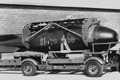 | Date: 1962-71 | Prod.: □ | Mass:~800kg | Dropcase: 366cm x 71cm | Type:Fission | Yield:10-25kt |
The first British tactical nuclear weapon, featured an implosion-type fission warhead that utilised a composite core of plutonium and uranium-235. Two versions were produced: Mk.1 - yield of 15 kilotons. Mk.2 - yield of 25 kilotons. None of the variants allowed in-flight arming of the fissile core, the core was inserted before take-off. The dropcase had retractable tail fins to maximize clearance inside internal weapon bays. Tested during the British nuclear tests at Maralinga in 1956, codenamed Buffalo R1/One Tree.
|
|
Red Snow
|
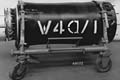 | Date:1961–72 | ~Prod.:>150 | Mass: □ | Case: □ | Type:TN | Yield:~1.1Mt |
Thermonuclear warhead, an 'Anglicised' copy of the U.S. W28 warhead. Due to British safety and manufacturing requirements, the warhead was too large for the U.S. casings. Consequently it was deployed in the larger Yellow Sun Mk.2 gravity bomb & Blue Steel standoff missile. It used the boosted composite uranium/plutionium 'Peter' primary stage, an Anglicised version of the US Python device.
|
|
Blue Steel
|
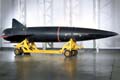 | Date:1963–70 | ~Prod.:53 | Mass:7.7 Tons | Ccase:10.6m X 1.2m | Type:TN | Yield:1.1Mt |
Air-launched, rocket-propelled nuclear stand-off missile designed as a primary airborne nuclear deterrent. Built by Avro to arm the RAF's V-bomber force. The Stentor rocket engine relied on High-Test Peroxide (HTP) and aviation kerosene. HTP is highly volatile and prone to spontaneous combustion, requiring ground crews to wear full protective suits during the fueling process. Originally designed for high-altitude release, this shifted to low-level penetration which drastically reduced the missile's operational range. Operational speed was Mach 2.3, the guidance inertial, and utilised a Red Snow thermonuclear warhead. It required seven hours to prepare, and was highly unreliable.
|
|
Yellow Sun
|
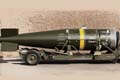 | Date:1959-66 | ~Prod.:>200 | Mass:3.3 tons | Case:6.4m x 1.2m | Type:Var. | Yield:~1Mt |
Aerodynamic dropcase designed to house interchangeable warheads. It featured a flat nose designed to increase drag to slow its descent, giving RAF V-bombers time to escape the blast. It also prevented supersonic shock waves from interfering with its barometric altitude fuses. It used dual ram-air turbines behind the air intakes in its nose to generate electrical power during its fall, replacing unreliable lead-acid batteries. Two variants: Mk1 - Interim "emergency capability" weapon. Armed with the Green Grass layer-cake type unboosted pure-fission warhead, yield 400kt. Mk2: Warhead upgraded to the Red Snow thermonuclear warhead, a U.S. W28 warhead variant. | Loading |
|
|
Red Snow
|
| Date:1961–72 | ~Prod.:>150 | Mass:1.4 Tons | Case: □ | Type:TN | Yield:~1Mt |
Anglicised version of the U.S. W28 thermonuclear warhead. It used a a modified gas-boosted fission 'Peter' primary based on the U.S. W34 Python primary. Despite being based on a U.S. design, it was manufactured in Britain using British fissile materials. There were kiloton Red Snow and megaton Red Snow" variants of the weapon, but specifics remain classified. It was deployed in the Yellow Sun Mk-1/2 dropcase, and the Blue Steel stand-off missile.
|
|
Blue Peacock
|
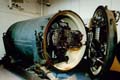 | Date:1963–70 | ~Prod.:2 | Mass:7,300kg | Case: □ | Type:Fission | Yield:10kt |
Top-secret tactical nuclear weapon project to create nuclear landmines to be buried in Germany to deter a Soviet invasion of Western Europe. Designed around the Blue Danube fission warhead. The weapon could be detonated via three methods: by wire from 4.8km, an eight-day timer, or by interference with the anti-tampering devices. There were concerns the mine could cease working due to low winter temperatures. One 'proposal' suggested using live chickens sealed inside the casing, with a supply of food and water. They would remain alive for approximately a week, their body heat keeping the mine's components at a working temperature.
|
|
Blue Water
|
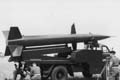 | Date:1960–62 | Prod.: □ | Mass:1.4 Tons | Case:760cm X 61m | Type:Fission | Yield:10kt |
Designed by English Electric as a mobile, short-range battlefield weapon to replace the obsolete MGM-5 Corporal missile. Powered by a modified Cuckoo solid rocket motor used Black Knight, developed by PERME and manufactured by Bristol Siddeley Engines. Intended to carry a 10-kt nuclear warhead codenamed 'Tony', a British adaptation of the American W44 warhead Tsetse primary. The transporter erector launcher was a modified Bedford RL lorry. Additional launch equipment consisted of an early electronic computer, carried in a Land Rover, together with an onboard alignment theodolite.
|
|
Orange Herald
|
 | Date:1960–62 | Prod.: □ | Mass:1.4 Tons | Case:760cm X 61m | Type:Fission | Yield:720kt |
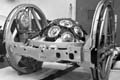
Boosted fission nuclear weapon tested during Operation Grapple, the largest single-stage fission device ever tested. Publicised as a hydrogen bomb, but it was actually a fusion-boosted fission weapon. Fusion boosted using a small amount of lithium deuteride and tritium, though the yield suggested very little actual fusion took place. The first British nuclear device to use an external neutron source. |Test Video|
|
|
WE.177
|
 | Date: 1966-98 | Prod.:~270 | Mass:270-457kg | Dropcase:Var. | Type:TN/Fission | Yield:0.5-450kt |
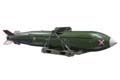
Air-dropped nuclear weapon based on the U.S. W59 warhead. Three main variants: WE.177A - (mass-272kg) variable fission only yields 0.5kt or 10kt. WE.177B - (mass-457kg) thermonuclear yield 450 kt. WE.177C - (457kg) thermonuclear yield 190kt. The weapons were developed to provide low-level, parachute-retarded delivery. Unlike earlier British designs, the arming units and fissile warheads were sealed entirely inside the outer casing. Part of the safety and arming system was a simple key-operated Strike Enable Facility; using a cylindrical barrel key similar to those used on vending machines. The key profile for each live weapon was unique.
|
The Rainbow Codes were a series of code names used to disguise the nature of various British military research projects. They were mainly used by the Ministry of Supply from the end of the Second World War until 1958. Each rainbow code name was constructed from a randomly selected colour, plus a noun taken from a list. For example:
'Blue' + 'Steel' = Blue Steel - stand-off missile
'Green' + 'Grass' = Geen Grass - Warhead
|
|
|
|