 |
|
Home / Articles >
|
Project Sundial
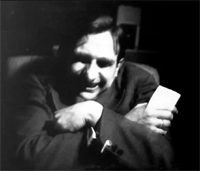
Edward Teller
|
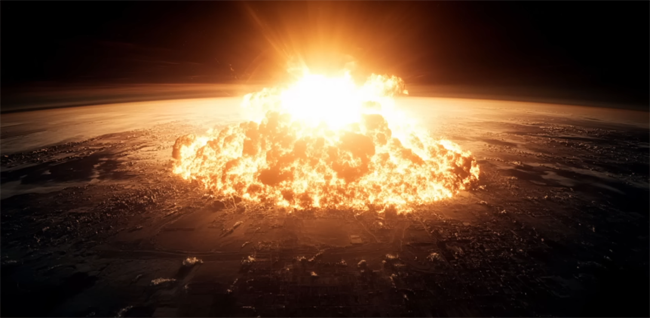
Sundial was the codename for one of two massive nuclear bombs planned for testing by the University of California Radiation Laboratory. Announced by Edward Teller at a meeting of the General Advisory Committee of the Atomic Energy Commission, it was intended to have a yield of 10 gigatons of TNT, while its counterpart, Gnomon, was intended to have a yield of 1 gigaton. If you dropped a Hiroshima sized bomb every minute, it would take over 15 months to equal the explosive power of the Sundial device.
Even before the first atomic bomb was built, scientists in the United States had conceived of an even larger weapon, the 'Super', which would use the energy of a fission bomb to power nuclear fusion reactions in the heavy hydrogen isotopes deuterium and tritium. Resulting in a weapon multiple orders of magnitude more powerful than one fueled by fission alone. This idea was proposed by Italian physicist Enrico Fermi in September 1941. Such a weapon, they reasoned, could be scaled up to the megaton range, a thousand-fold increase over the kiloton weapons they were contemplating for World War II. Los Alamos researchers were doing calculations on theoretical fission-ignited fusion bombs with yields of 100 megatons by 1944.
"A decision on the proposal that an all-out effort be undertaken for the development of the 'Super' cannot in our opinion be separated from considerations of broad national policy. Necessarily such a weapon goes far beyond any military objective and enters the range of very great natural catastrophes. By its very nature it cannot be confined to a military
objective but becomes a weapon which in practical effect is almost one of genocide."
- Isidor Isaac Rabi - October 1951
|
|
By the spring of 1951, Hungarian physicist Edward Teller and Polish mathematician Stanislaw Ulam at Los Alamos had developed their design for a workable hydrogen bomb. The idea was superficially simple: Use the radiation of an fission bomb ('primary') to compress a capsule that contained both fusionable and fissionable materials ('secondary').
Radiation implosion was the key, the high energy x-rays emitted by the primary were able to reach the secondary before the heat and blast from the primary. As immensely high pressures and temperatures are required to create a fusion reacton, the xrays ablate the outside of the secondary casing, in effect making the surface a rocket pushing inwards. Later designs also used a fissioning rod of plutonium, a 'spark plug' pushing against the fuel capsule from the inside as well, heating it to 300 million kelvin and exerting pressures of several million bars.
A proof-of-concept the radiation implosion concept was tested in November 1952 with shot Mike of Operation Ivy using liquid deuterium, achieving an explosive yield of 10.4 megatons. A more compact, weaponized version was detonated in March 1954 that used a solid lithium deuteride fusion fuel during the Castle Bravo test.
The exact contributions provided respectively from Ulam and Teller to what became known as the Teller–Ulam design is not definitively known. However, Teller later claimed Ulam's contributions were negligible, with Teller being colloquially as "the father of the hydrogen bomb" to this day.
The Proposal
Teller had relentlessly promoted the hydrogen bomb, despite strong protests from many of the major scientific contributors to the development of the atomic bomb for being excessively destructive. He was also a major driving force behind the US Strategic Defense Initiative, derisively nicknamed the Star Wars program. A proposed missile defense system intended to protect the United States from attack by ballistic nuclear missiles. A project heavily criticized for threatening to destabilize MAD and re-ignite "an offensive arms race".
Yet here was Edward Teller right at the front end of a drive to push the world closer to nuclear Armageddon.
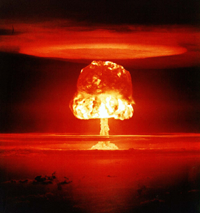
Romeo Castle - 26/03/1954
|
In July 1954, Teller made it clear he thought 15 megatons was child’s play. At a secret meeting of the General Advisory Committee of the Atomic Energy Commission, Teller broached, as he put it "the possibility of much bigger bangs". At his Livermore laboratory, he reported, they were working on two new weapon designs, dubbed Gnomon and Sundial. Gnomon would be 1,000 megatons and would be used like a 'primary' to set off Sundial, which would be 10,000 megatons.
Most of Teller’s testimony remains classified to this day, but other scientists at the meeting recorded, after Teller had left, that they were shocked by his proposal. Physicist Isidor Isaac Rabi, by then an experienced Teller skeptic, suggested it was probably just an 'advertising stunt'. But he was wrong.
Livermore would for several years continue working on Gnomon, and had even planned to test a prototype for the device in Operation Redwing in 1956. Thankfully the test never took place.
The true insanity of a nuclear bomb this powerful is hard to encompass. While conventional delivery systems relied om aircraft or ICBMs, Sundial took a different approach. An explosion so powerful that it was known as a 'back yard' bomb, as in it didn't actually matter where you detonated it, it would be the end would of the world, truly a 'doomsday device'. This actually fits in with the doctrine of MAD (mutually assured destruction). Attack us, and we end the world being a valid extension of the principles of MAD. Deterrence taken to it's ultimate conclusion, a binary proposal, peace or extinction.
If built and detonated, Sundial would have created a fireball up to 50km in diameter, larger than the visible horizon. An explosive equivalent of ten billion tones of TNT, a number so big that it loses any comprehensible meaning. Anything within 400km would be instantly ignited, causing a magnitude 9 earthquake to roll around the earth causing massive tsunamis. The surrounding lands would be turned into endless fields of radioactive glass, with the atmosphere above the blast shot into space.
Conclusion
Sundial represented a departure from conventional nuclear weapon design. The projected effects of such a vast weapon crossed from tactical warfare, into planetary alteration. It was thought that the explosion would lead to an apocalyptic nuclear winter, drastically lowering global temperatures and contaminating water sources, resulting in what amounted to an extinction event. Sundial was full scale nuclear war, but encapsulated in one event. Most people in the world would die.
Sundial was never built, but plans for it were drawn up. However common sense prevailed and it was not considered a viable solution to the problems of the Cold War.
|
|
|
|