 |
|
South Africa's Nuclear Weapon Program
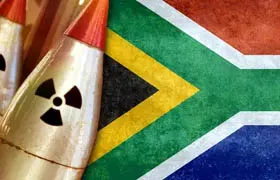
From the 1960s to the 1990s, South Africa pursued research into weapons of mass destruction, including nuclear, biological, and chemical weapons under the apartheid government. South Africa is one of the ten states to ever acquire a nuclear weapons capability, and the only state to relinquish them
The Republic of South Africa's ambitions to develop nuclear weapons began in 1948 after commissioning the South African Atomic Energy Corporation (SAAEC). In 1957, South Africa reached an understanding with the U.S. after signing a 50-year collaboration under the U.S. sanctioned program, Atoms for Peace.
The treaty concluded the South African acquisition of a single nuclear research reactor and an accompanying supply of highly enriched uranium (HEU) fuel, located in Pelindaba. South Africa was able to mine uranium ore domestically, and used aerodynamic nozzle enrichment techniques to produce weapons-grade material.
Weapon production
The South African covert nuclear weapons production line and high security storage vaults were located in the Kentron Circle building on the Gerotek vehicle testing facility owned by Armscor on the outskirts of Pretoria. At its secret opening ceremony on 4 May 1981, Prime Minister P.W. Botha described the nuclear deterrent as a "political weapons system" rather than a military one, as it would primarily be used for leverage in international negotiations.
South Africa developed a small finite deterrence arsenal of gun-type fission weapons in the 1980s. Six were constructed and another was under construction at the time the program ended. South Africa ended its nuclear weapons program in 1989 and acceded to the Treaty on the Non-Proliferation of Nuclear Weapons in 1991.
Collaboration with Israel
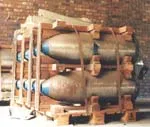
Bomb casings
|
South African projects to develop nuclear weapons during the 1970s and 1980s were undertaken with long-term cooperation from Israel.
According to the Nuclear Threat Initiative, in 1977 Israel traded 30 grams of tritium for 50 tonnes of South African uranium, and in the mid-1980s assisted with the development of the RSA-3 and RSA-4 ballistic missiles, which are similar to the Israeli Shavit and Jericho missiles. Also in 1977, according to foreign press reports, it was suspected that South Africa signed a pact with Israel that included the transfer of military technology and the manufacture of at least six nuclear bombs.
In September 1979, a US Vela satellite detected a double flash over the Indian Ocean that was suspected, but never confirmed, to be a nuclear test, despite extensive air sampling by WC-135 aircraft of the United States Air Force. If the Vela incident was a nuclear test, South Africa is virtually the only possible country, potentially in collaboration with Israel, which could have carried it out. No official confirmation of its being a nuclear test has been made by South Africa.
Unlike many other countries' nuclear weapons doctrines, South Africa's strategy anticipated no actual battlefield use of nuclear weapons. Although the weapons were intended to be used as a basis for a bluff against its antagonists, South Africa had to be perceived as having the means and resolve to use nuclear weapons in a military conflict. The goal was not to be involved in a nuclear war that South Africa could not survive; the goal was to deter the potential aggression of the country's enemies.
|
|
|
|