|
Project Plowshare - 1957/1973
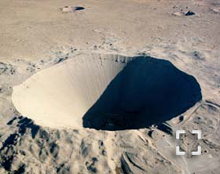
Sedan Crater
|
The Atomic Energy Commission (AEC) established the Plowshare Program in June 1957 to explore the peaceful uses of nuclear energy. The program took its name from the Bible (Isaiah 2:4), "they will beat their swords into plowshares". The idea of using nuclear explosions for non-military purposes was first raised by President Dwight D. Eisenhower in his famous 'Atoms for Peace' speech in December 1953. By exploiting the peaceful uses of the 'friendly atom' in medical applications, earth removal, and later in nuclear power plants, the nuclear industry and government sought to allay public fears about nuclear technology and promote the acceptance of nuclear weapons.
In 1956 a symposium was held on the subject with proposals covering a broad array of ideas. While interest was high, discussions were hampered by the lack of actual data on the effects of underground nuclear explosions. This data was generated in 1957 with the first underground nuclear explosion shot Rainier during Operation Plumbbob. While not officially a Plowshare test, the data and confidence generated from the event proved pivotal to the nascent Plowshare Program.
Unlike most US test series which had a narrow objective set to be achieved within a single fiscal year, Project Plowshare spanned 20 years, 27 test shots and 13 separate operations. The assignment of Plowshare tests to individual 'operations' during the course of Plowshare is a little confusing due to overlapping operations and conflicting documentation, with some shots being assigned to more than one. Plowsare tests were conducted amidst other test series consisting of multiple tens of shots, of which only one or more qualified as actual 'Plowshare' tests. This emphasizes the nature of Plowshare as a concept and political objective, rather than an American nuclear test series in the conventional sense.
On the 31st of August 1961, First Secretary Nikita Khrushchev announced that the Soviet Union was abruptly abandoning the nuclear testing moratorium, which they (and the US) had observed for 34 months. The next day the Soviet Union began an atmospheric test series of unprecedented magnitude. Starting with a 16 kiloton test, and two months later the 50 megaton Tsar Bomba, the largest nuclear weapon ever detonated.
Two weeks after Khrushchev's announcement, the U.S. responded by initiating Operation Nougat, consisting of a total of 44 tests, all underground. Nougat was actually the first US underground test series.
Gnome - 1961 |Nougat|
Gnome was shot seven of Operation Nougat, and is considered the first Plowshare test. Gnome was a multipurpose experiment designed to explore using a buried explosion in a salt bed for isotope production, power recovery and scientific experiments. Gnome involved the detonation of a 3.1 Kt nuclear device at 365m below the surface, creating a 21m high, 50m diameter cavity near Carlsbad, New Mexico.
The test had many objectives, the most public being steam generation to produce electricity. Another objective was the production of useful radioisotopes and their recovery, a fourth experiment involved geophysical studies based upon the timed seismic source. Only the last objective was considered a complete success. The blast unintentionally vented radioactive steam while the press watched. The partly developed Project Coach experiment that was to follow adjacent to the Gnome test was subsequently canceled.
Sedan - 1962 |Storax|
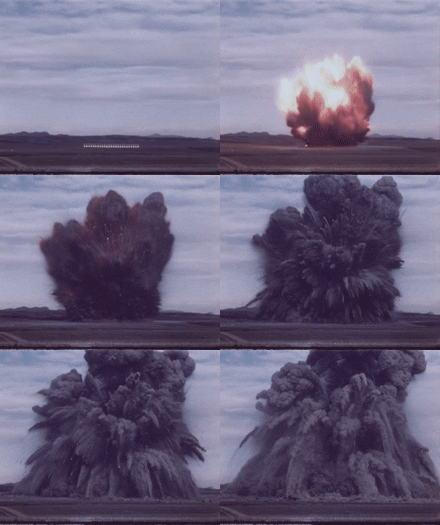
The second Plowshare test was Sedan of Operation Storax, which comprised of a series of no less than 47 nuclear tests. The timing of the Sedan was within the Operation Storax fiscal year, but was functionally part of Operation Plowshare. The purpose of the 104 Kt Sedan test was to investigate the use of 'clean' thermonuclear devices for producing large craters cheaply. Twelve million tons of soil and rock were lifted into the air, with eight million tons of it falling outside the crater. The final crater was 390m wide and 97m deep. It released seismic energy equivalent to 4.75 on the Richter Scale. Storax tests Anacostia (5.2 Kt - 27/11/1962) and Kaweah (3 Kt - 21/02/1963) qualified as test three and four of Plowshare.
There was an emphasis on the use nuclear explosives that were as close to pure fussion as possible to reduce radioactive contamination. This fell in line with the Plowshare narrative to make the almost casual use of nuclear explosives acceptable.
Gasbuggy - 1967 |Crosstie|
 Three joint government-industry experiments were conducted to investigate the feasibility of using nuclear explosions to stimulate natural gas production. In 1967, the 19th Plowshare test Project Gasbuggy was carried out by LLNL in participation with the El Paso Natural Gas Company. While Gasbuggy's results were initially encouraging, with an increase in gas production six to eight times over previous rates, the quality of the gas produced showed some 'undesirabilities'. Undesirable being a euphemism for contaminated.
After an initial surface cleanup the site sat idle for over a decade. A later surface cleanup effort primarily tackled leftover toxic materials. In 1978, a marker monument was installed at the Surface Ground Zero point that provided basic explanation of the historic test. Below the main plaque lies another that indicates that no drilling or digging is allowed without government permission. Following Gasbuggy but not included in Project Plowshare, two nuclear explosion fracturing experiments were conducted in western Colorado in an effort to refine the technique. They were Project Rulison in 1969 and Project Rio Blanco in 1973. In both cases the gas radioactivity was still seen as too high. These early fracturing tests were later superseded by hydraulic fracturing technologies.
The other Plowshare tests were conducted under Operations Niblick, Whetstone, Flintlock, Latchkey, Crosstie, Bowline, Mandrel, Grommet and finally Operation Toggle in 1973.
Other Testing Proposals
Other proposed uses for nuclear explosives under Project Plowshare included widening the Panama Canal. Another, Project Chariot, which would have used several hydrogen bombs to create an artificial harbor at Cape Thompson, Alaska. It was not carried out due to concerns for the native populations and the fact that there was little potential use for the harbor to justify its risk and expense. Then there was Project Carryall in 1963 which proposed using 22 nuclear explosions to excavate a massive roadcut through the Bristol Mountains in the Mojave Desert, for a new Interstate rail line.
Another project proposed in a 1963 memorandum by LLNL would have used 520 2-megaton nuclear explosions to excavate a canal through the Negev Desert in Israel at an estimated cost of $575 million ($6B USD in 2025), to serve as an alternative route to the Suez Canal.
Non-nuclear tests
In addition to the nuclear tests, Plowshare conducted 19 non-nuclear test projects to learn more about how the nuclear explosives could best be used. Several of these projects led to practical utility as well as to furthering knowledge about large explosives.
One notable example is Project Dugout in 1965. Conducted by the U.S. Army Engineer Waterways Experiment Station Corps of Engineers, it was intended to contribute to preparations for Plowshare Project Buggy. The purpose was to increase the knowledge of row cratering in rock using spaced chemical explosive charges.
Soviet PNE Program - 1965-1989
There was a Soviet PNE program called 'Nuclear Explosions for the National Economy' that ran in parallel to the United States program Operation Plowshare. Initially, the Soviet program was focused on two applications, nuclear excavation and petroleum stimulation. One such operations was Butan in 1965 which used nuclear explosives to stimulate the release of butane and oil from subterranean deposits at the Grachevskij oil field. The Soviet PNE program was many times larger than the U.S. program in both the number of applications explored and the extent to which they were introduced into industrial use.
Another notable example was using a 30 kiloton nuclear explosive to successfully seal off the Urtabulak gas well that was burning out of control. It was listed as a 'seismic event' by the Soviets to conceal the true nature of the ordnance used.
One of the better-known and first Soviet PNE tests was Chagan in 1965, a huge 140 Kt blast that created a radioactive man-made lake dubbed Lake Balapan. Radioactivity from the test was detected over Japan and the the U.S.in apparent violation of the 1963 Partial Test Ban Treaty.
Conclusion
While 27 nuclear tests were conducted in the Plowshare Program between 1957 and 1973 to develop such peaceful use technology, environmental concerns, as well as opposition to nuclear energy and nuclear devices, led to the demise of the program. Project Plowshare was officially terminated in 1977.
However important legacies from the Plowshare Program live on at LLNL, including the biomedical program first established to study the effects of fallout and
other radioactive hazards on biological systems, and the Atmospheric Release and Advisory Capability (ARAC) program, now NARAC, which grew out of the need to predict the potential for atmospheric release from cratering shots.
Project Plowshare film
|
Test Shots
| Video |
Name |
Yield |
Date |UTC| |
Test Series |
Tests |
 |
Gnome |
3.1 Kt |
10/12/1961 |
Nougat |
44 |
|
Sedan |
104 Kt |
06/07/1962 |
Storax |
47 |
| - |
Anacostia |
5.2 Kt |
27/11/1962 |
Storax |
47 |
| - |
Kaweah |
3 Kt |
21/02/1963 |
Storax |
47 |
| - |
Tornillo |
0.38 Kt |
11/10/1963 |
Niblick |
41 |
| - |
Klickitat |
70 Kt |
20/02/1964 |
Niblick |
41 |
| - |
Ace |
3 Kt |
11/06/1964 |
Niblick |
41 |
| - |
Dub |
11.7 Kt |
30/06/1964 |
Niblick |
41 |
| - |
Par |
38 Kt |
09/10/1964 |
Whetstone |
46 |
| - |
Handcar |
0.9 Kt |
05/11/1964 |
Whetstone |
46 |
| - |
Sulky |
12 Kt |
05/11/1964 |
Whetstone |
46 |
| - |
Palanquin |
4.3 Kt |
14/04/1965 |
Whetstone |
46 |
| - |
Templar |
0.37 Kt |
24/03/1966 |
Flintlock |
47 |
| - |
Vulcan |
25 Kt |
25/06/1966 |
Flintlock |
47 |
| - |
Saxon |
1.2 Kt |
11/07/1966 |
Latchkey |
38 |
| - |
Simms |
2.3 Kt |
06/11/1966 |
Latchkey |
38 |
| - |
Switch |
3.1 Kt |
22/06/1967 |
Latchkey |
38 |
| - |
Marvel |
2.2 Kt |
21/09/1967 |
Crosstie |
48 |
| - |
Gasbuggy |
29 Kt |
10/12/1967 |
Crosstie |
48 |
| - |
Cabriolet |
2.3 Kt |
26/01/1968 |
Crosstie |
48 |
| - |
Buggy |
5x 1.1 Kt |
12/03/1968 |
Crosstie |
48 |
| - |
Stoddard |
31 Kt |
17/09/1968 |
Bowline |
47 |
|
Schooner |
30 Kt |
08/10/1968 |
Bowline |
47 |
| - |
Rulison |
43 Kt |
10/09/1969 |
Mandrel |
52 |
| - |
Flask Green |
105 Kt |
26/04/1970 |
Mandrel |
52 |
| - |
Flask Yellow |
0.9 Kt |
26/04/1970 |
Mandrel |
52 |
| - |
Flask Red |
0.4 Kt |
26/04/1970 |
Mandrel |
52 |
| - |
Miniata |
83 Kt |
08/07/1971 |
Grommet |
34 |
| - |
Rio Blanco 1-3 |
3x 33 Kt |
17/05/1973 |
Toggle |
28 |

| - DNA 6029F - Defense Nuclear Agency report - PLOWSHARE Gnome and Sedan
|
|