 |
|
Home / Articles >
|
Pimple Phenomena
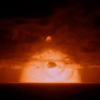
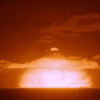
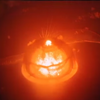
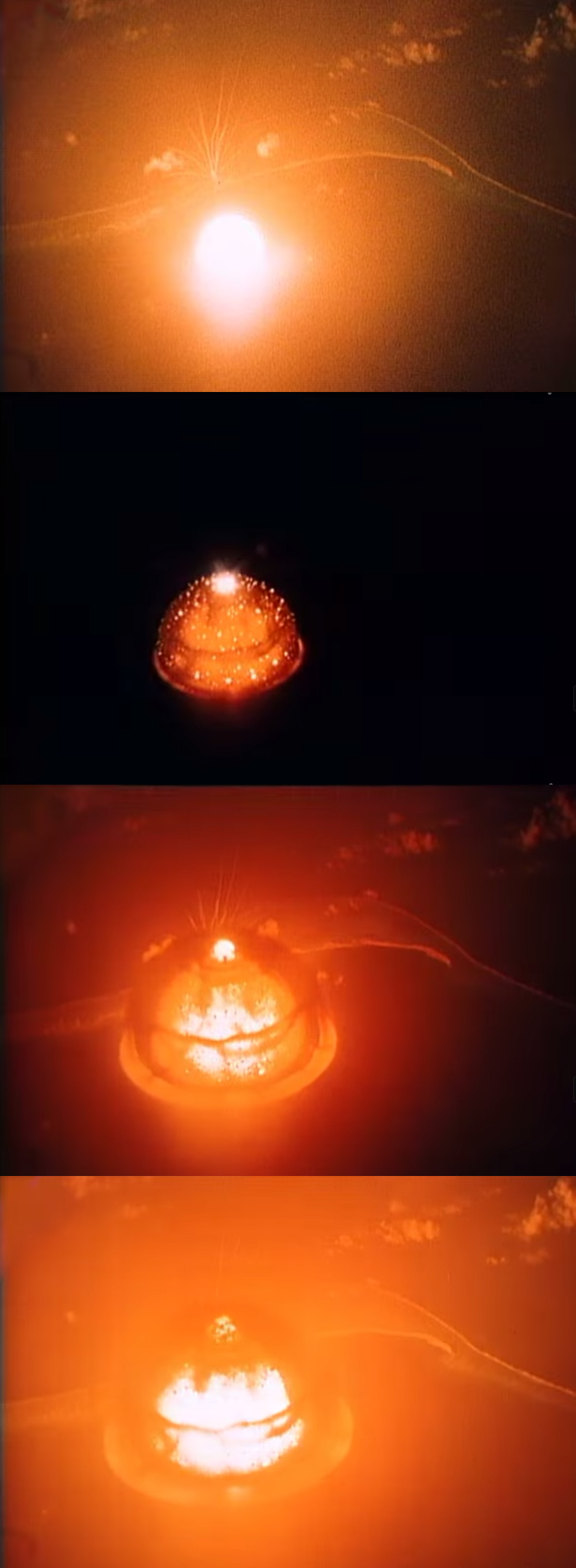
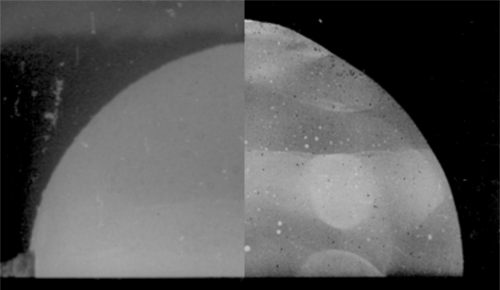
 An interesting phenomenon can be seen during shots Romeo, Union and Nectar of Operation Castle, Apache Navajo and Tewa of Operation Redwing, and shot Poplar of Operation Hardtack. A pimple or complete miniature fireball is ejected from the top of the main fireball. All the test shots that exhibited this phenomenon were over 100 kilotons, and fired from floating barges. Barges were used extensively during the Pacific testing from 1954 through to 1958 due to the diminishing remaining land mass.
The speed of a shockwave is reduced when traveling across the water surface, shockwave dynamics inside large nuclear fireballs also behave differently over water. Vaporized water is drawn into the fireball in a process called material entrainment. This causes additional cooling, retards the expansion of the fireball and creates internal asymmetry.
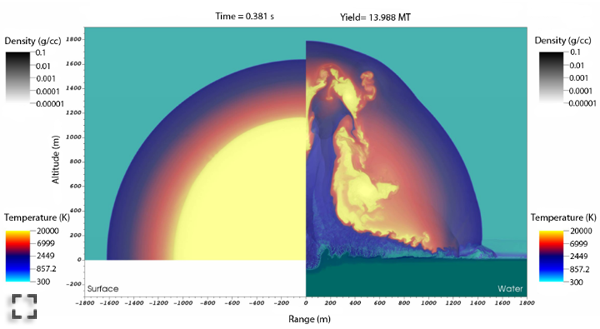
With the advent of modern high-performance computing, simulations have become capable of capturing previously neglected physics; e.g., the mass of water vaporized by the fireball and entrained by the shock, information not available in the historical films or measurement data. This presented an opportunity to study the effect of high Mach number shock waves on the air-water interface. Low Mach number shock waves can be created and studied in a laboratory, but the only way to create shock waves in the order of Mach 100 is to detonate a nuclear weapon, or by computer simulation.
Investigations have been conducted by the Lawrence Livermore National Laboratory (LLNL) using simulation software called Miranda. The goal being to gain a greater understanding of how nuclear fireball interactions with water have created inaccuracies in historical yield calculations. This has been made possible by the LLNL films declassified and re-analyzed as a part of their 2007 film scanning and re-analysis project.
An additional benefit of these studies has been a better understanding of the pimple phenomenon seen in the historic test film archive.
 |
|
The Bravo shot over land verses the Yankee shot over water.
|
 |
|
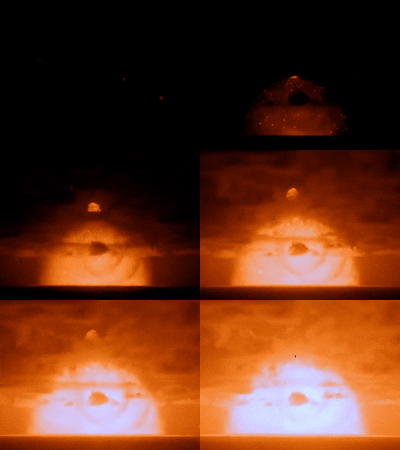
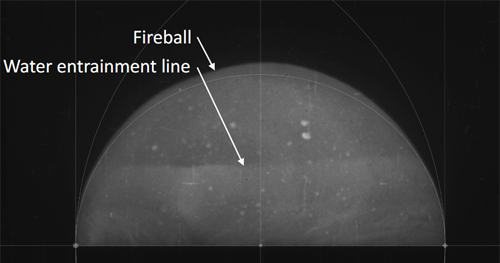
The water entrainment line is the upper boundary of the band of
brightness at the bottom of the fireball. Dark areas at the corners
of the shock wave show the predicted cross sectional funnel shape.
|
 |
|
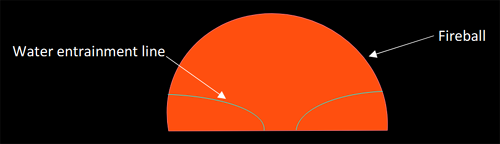
Predicted cross sectional view of the nuclear fireball.
|
|
|
Miranda simulation of a blast over highly reflective land verses over water.
|
This would indicate that in three dimensions, the water entrained inside the shockwave would form a funnel. In some of the films where the water entrainment line is seen and the film is not overexposed, a cross sectional shape appears indicating that the predicted shape is accurate.
Summary
The reflection of the initial shockwave over water creates a funnel shaped mass of vaporised intrained water in the lower half of the fireball. After the fireball has grown enough to cool at the surface, reheating occurs. Heat from the still very hot isothermal sphere in the center flows out to the fireball surface warming it. The vertical axis of the funnel having very little radiation opacity, allows a rapid flow of material vertically, with an ejection of a small and extremely hot mini plume top dead center.
Source material and further reading -
- Water Entrainment in Nuclear Detonations - 2018
- New Yield Estimates for Nuclear Det on Water - 2020
- Yield Analysis of Nuclear Fireballs - 2018
- Light Output + Thermal Blast Analysis of Nuclear Fireballs - 2018
|
- Click on a thumbnail for a larger version
|
|
|
|
|