 |
|
North Korea's Nuclear Weapon Program
North Korea has the world's smallest stockpile of nuclear weapons, with an estimated 60 warheads and production of fissile material for six to seven warheads per year. North Korea is the tenth country to develop and most recent to openly test nuclear weapons. Motives for North Korean nuclear proliferation include the fall of communism, a wavering alliance with China, and a desire to deter and/or negotiate with the United States.
North Korea had been suspected of maintaining a clandestine nuclear weapons development program since the early 1990s when it constructed a plutonium-producing Magnox nuclear reactor at Yongbyon. In 1994, the United States and North Korea signed the "Agreed Framework", whereby North Korea agreed to freeze its plutonium production program.
However, in 2002, it emerged that North Korea was pursuing both uranium enrichment technology and plutonium reprocessing technologies in defiance of the Agreed Framework. North Korea reportedly told American diplomats in private that they were in possession of nuclear weapons, citing American failures to uphold their own end of the "Agreed Framework" as a motivating force. North Korea later clarified that it did not possess weapons yet, but that it had a right to possess them.
In 2003, North Korea withdrew from the Nuclear Non-Proliferation Treaty after not receiving light-water reactors promised by the U.S. These reactors were to be delivered in exchange for North Korea not developing their own power plants, as understood in the Agreed Framework.
First test
Rumour of an impending nuclear test circulated during 2005 and early 2006, though none were conducted. Then on October 3, 2006, North Korea claimed that it would soon conduct a nuclear test, and on October 9, 2006, the state claimed to have successfully conducted a test.
The Korean Central News Agency issued the following statement:
|
"The field of scientific research in the DPRK successfully conducted an underground nuclear test under secure conditions on October 9, Juche 95 (2006), at a stirring time when all the people of the country are making a great leap forward in the building of a great, prosperous, powerful socialist nation."
|
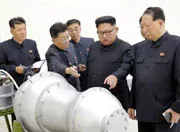
Kim Jong inspection 2017
|
According to initial reports from South Korean government sources, the test was carried out at a mountain in Musadan-ri in Hwadae-kun, near the city of Kilchu, in North Hamgyong province on the northeast coast. However, later reports from the state National Intelligence Service identified the site as being a place in Sangpyong-ri, about 15 km from the coastal city of Kimchaek and about 50 km west of Musadan-ri. The test was conducted in a horizontal tunnel which prevented the immediate or large scale release of radioactivity.
Questions were initially raised as to whether it was actually a nuclear explosion, but detection of airborne radioactive isotopes by a U.S. WC-135 Constant Phoenix sniffer aircraft confirmed this. The yield was estimated as less than a kiloton, some radioactive output was detected.
The low yield (less than a quarter of its reported planned yield) indicates that some aspect of the nuclear weapon design or material production did not function correctly. The North Koreans have high grade plutonium, so problems with predetonation are almost certainly not the cause. The most likely cause is poor implosion performance (that is, poor compression), though late initiation is also a possibility.
Further testing
25/05/2009, North Korea conducted its second underground nuclear test. The U.S. Geological Survey calculated its origin in proximity to the site of the first nuclear test. The test, estimated at 2 to 8 kilotons, was more powerful than the previous test.
12/02/2013 - Monitors in Asia picked up unusual seismic activity at a North Korean facility at 02:57 GMT, later determined to be an artificial quake with an initial magnitude 5.1. In The Korean Central News Agency subsequently said that the country had detonated a miniaturized nuclear device in an underground test. The estimated yield was 7.7–7.8 kilotons.
First claimed North Korean hydrogen bomb test
06/01/2016 - After reports of a magnitude 5.1 earthquake originating in northeast North Korea, the country's regime released statements that it had successfully tested a hydrogen bomb. Whether this was in fact a hydrogen bomb has yet to be proven. Experts have cast doubt on this claim.
09/09/2016 - Conducted on the country’s founding anniversary, this test was explicitly designated as a trial for a standardized, mass-producible nuclear warhead. Pyongyang stated it could now mount these warheads directly to strategic ballistic missiles. Estimated Yield: 10 to 20 kilotons
03/08/2017 - By far North Korea's most powerful test, triggering a massive magnitude 6.1 artificial earthquake that caused minor structural collapses inside the Punggye-ri mountain tunnels. Independent experts agree this was a true two-stage thermonuclear bomb, validating Pyongyang's capacity to cause catastrophic widespread damage. Estimated Yield: 140 to 250+ kilotons
Arsenal
North Korea continues to aggressively expand and modernize its nuclear arsenal, shifting from a purely deterrent posture to an explicitly offensive doctrine.
The Korean People's Army Strategic Force is estimated to operate over 363 ballistic missiles; 17 of these are intercontinental-range such as the Hwasong-17, another 27 are intermediate/medium-range such as the Hwasong-12, and the remaining 319 are short-range, primarily the Hwasong-11D. The Force also operates the Hwasal-1/-2 cruise missiles and reportedly tactical nuclear weapons. North Korea is developing submarine-launched ballistic missiles such as the Pukguksong-1 and Hwasong-11S.
|
|
|
|