 |
|
Home / Articles >
|
Hypothetical Thermonuclear Attack on London
|
At 11:34 GMT in a wooded area near Barnaul in Russia, a twelve-wheel mobile erector-launcher vehicle launches a 23 meter long 50 ton intercontinental ballistic missile (ICBM) from its massive launch tube. The engines ignite mid-air accelerating it upward toward its target 6,500 km away. Two minutes after launch the first stage falls away, and the second stage separates about a minute later. Now beyond the atmosphere the payload bus (the size of 1981 Honda Civic) is left to coast the rest of the way to the target. A shroud is thrown off to expose a cone-shaped warhead about 2 meters long. The warhead is mounted on the payload bus, which fires small rockets to reorient itself before ejecting the warhead. The warhead re-entry vehicle (RV) coasts silently through space before descending on a ballistic trajectory at a 23,000 km per hour (14,000 mph). As it enters the atmosphere, superheated ionized gas (plasma) forms around the RV due to the immense friction and aerodynamic forces.
At 11:59:35 AM a falling star appears in the lightly clouded skies over southern England, documented by hundreds of mobile phone cameras. It reaches a point 2 km above Trafalgar Square at 12:00:00 noon. Signals from both radar and air pressure sensors trigger an electronics package to begin detonation: time is now measured in microseconds, millionths of a second.
Electrical impulses are sent and divided to travel down wires to the 'primary'. After 0.003 microseconds these impulses reach detonators positioned at multiple points on a hollow shell of high explosives. This sphere is a layer of precisely shaped explosives designed so that the separate explosions converge into a perfectly spherical inward travelling implosion wave. After 10 microseconds the pressure wave begins to compress the tamper and the beryllium reflector layers. In 3 more microseconds this compression wave has crossed an air gap to reach the a 12 cm diameter sphere of uranium-235 at the center of the primary known as the pit.
The implosion wave compresses the uranium sphere to a fluid mass 5 cm in diameter which becomes supercritical. At 19 microseconds after detonation, a small particle accelerator inside the warhead fires neutrons into the uranium sphere. This triggers a cascade of splitting uranium atoms, each releasing more neutrons which in turn split more atoms. The inclusion of deuterium-tritium gas inside the pit adds additional high energy neutrons, boosting the efficiency of the reaction. This chain reaction cycles for about 80 generations.
This 5 cm sphere of uranium now has a temperature of 20,000,000°C, hotter than the center of the Sun.
The 'secondary' consists of a cylinder about the size of a thermos flask filled with lithium-deuteride (a solid isotope of hydrogen) at the rear of the warhead, with a shield protecting it from direct radiation from the primary. This cylinder is surrounded by a thick layer of natural uranium-238 known as the tamper. This jacket, because of its density, is designed to contain the fusion reaction for as long as possible. There is also a beryllium reflector shell that reflects stray neutrons back into the core. The secondary also has a rod of plutonium at its centre known as a 'spark plug'.
The x-rays from the primary are channeled through the bomb casing ahead of the heat and blast to the secondary, creating intense radiation pressure. These x-ray photons heat the surface of the uranium pusher sufficiently that it ablates, boiling vaporized uranium off its outer surface. The ablating vapour functions like a rocket accelerating the pusher shell inward at several hundred kilometers per second, compressing the deuterium to tens of billions of times normal atmospheric pressure.
The neutrons from the primary now arrive at the inner rod of plutonium through a hole in the radiation shield. This causes the rod to fission, adding vast amounts of heat and pressure perpendicular to the crushing forces on the outside. Temperatures and pressures are high enough that colliding tritium and deuterium atoms (both forms of hydrogen) merge into helium atoms instead of bouncing off each other. The fused atom has less mass than the two separate atoms, the lost mass is released as energy. This fusion reaction lasts another microsecond before tearing itself to pieces ending the reaction. At this point, 20 microseconds after detonation, the temperature is 300,000,000°C, twenty times hotter than the center of the Sun.
Lastly high energy neutrons from the fusion reactions cause the normally non-fissile uranium-238 tamper to undergo fast fission, and in this last tenth of a microsecond the energy released is nearly doubled.
At 0.000002 seconds after detonation, the process is complete and the warhead is beginning to disintegrate from within. Gamma radiation from the nuclear reactions has already radiated up to 400 meters in every direction. A region of space over London the size of a truck is now as hot as the centre of the Sun, and contains the equivalent explosive energy of 900 thousand tons of TNT.
This enormous release of gamma radiation is absorbed by the surrounding air, heating it to a point where it releases radiation itself. This process forms a fireball and decreases the energy of the radiation: from gamma rays to x-rays to ultraviolet, visible light, infrared, and radio waves. An electromagnetic pulse (a very brief pulse of radio waves) is emitted, collecting in metal objects and creating a power surge that damages or destroys electronics. In 0.00005 seconds nearly every computer chip in London is destroyed.
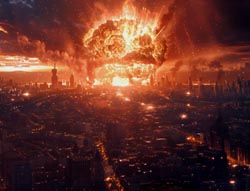
By 0.0007 seconds the fireball is 130 meters across. Continuing to expand at many times the speed of sound, the fireball forms two distinct regions: the centre remains extremely hot while the temperature of the outer part falls as it pushes the surrounding air away. The heat radiated by the outer layer produces an initial flash of light as bright as the Sun to an observer 40 km away at 0.005 seconds after detonation. The fireball brightness decreases until 0.08 seconds after detonation, when the fireball is as bright as the Sun to an observer 7.5 km away, and breakaway occurs: a blast wave separates from the fireball's surface. The blast wave is an expanding sphere of highly compressed and fast moving air. Initially the blast wave travels at ten times the speed of sound. The wave pushes the air away before it so that a partial vacuum is created behind it. The blast wave is reflected from the ground reinforcing itself and creating an even more destructive pressure front.
The clouds over London are pushed away clearing a space for the blossoming fireball. At a distance of 9 km, 19 seconds after detonation it finally drops to the speed of sound.
At breakaway (0.08 seconds after detonation) the fireball is 1.0 km across with a surface temperature of 1,300°C. Now that the fireball is no longer pushing the blast wave before it, the outer layer is reheated by the interior to reach a uniform temperature. As the fireball expands and rewarms, a second flash begins. The fireball now begins to release the large amount of thermal energy it contains, with catastrophic consequences for anything or anyone in the vicinity. At 1.07 seconds after detonation the fireball is 1.8 km in diameter and has a surface temperature of 6,000°C, greater than the surface temperature of the Sun. It would appear 500 times as bright as the Sun to an observer 10 km away. So far the fireball has radiated 22% of the thermal energy that it contains. The fireball has started to rise rapidly, like a hot air balloon, and its surface temperature and brightness begin to decline. However, it continues to expand until at 8 seconds after detonation it reaches its maximum size of 2.1 km. With a surface temperature of 2,100°C the fireball is still 15 times as bright as the Sun at a distance of 10 km; at this point 90% of the thermal radiation has been emitted.
The heat from above ground zero ignites anyone caught outdoors and causes cars to burst into flame in the first tenth of a second. At 12:00:01.3 buildings explode as moisture in the concrete and brick becomes superheated, cars vaporize. Over the next few seconds everything below the fireball is melted and fused.
At 1.8 km from the hypocentre, in an area encompassing Buckingham Palace and Westminster, people and cars ignite at 12:00:00.8; steel and glass melt and concrete and stone explode at 12:00:02.8; and at 12:00:03.1 the blast wave completely destroys all buildings.
Water in the Thames from Vauxhall in the south to Aldgate in the east is instantly vaporized.
At 2.4 km in an area encompassing Chelsea and the Elephant and Castle, people are instantly blinded, and those exposed have blistering burns at 12:00:00.1. At 12:00:00.5 some fires start and car tires melt; at 12:00:01.0 everything exposed that could possibly burn does and exposed people ignite; at 12:00:02.0 car metal melts, windows soften, and some people shielded from the fireball's light have received fatal burns from the glare. Other than the effects of the flash, the explosion is silent until the blast arrives, leveling buildings and killing any survivors at 12:00:03.9. Some of the rubble and burning debris from closer to the hypocentre are blown past at 1.4 times the speed of sound. By 12:00:07.2 the winds have reversed direction and begin blowing inward at well over hurricane force for several seconds.
At 2.9 km some fires and fatal burns are produced at 12:00:00.6. At 12:00:01.0 most exposed combustibles and persons ignite; at 12:00:04.8 the blast destroys all buildings.
At 3.3 km, all exposed persons receive fatal burns and some fires start at 12:00:00.7. At 12:00:01.1 painted surfaces explode and people ignite. At 12:00:05.6 the blast arrives destroying all buildings.
At 4.0 km out in Islington, some fires start and exposed persons find their skin melting off at 12:00:00.7, these people ignite at 12:00:01.2, and all exposed combustibles are burning by 12:00:01.7. At 12:00:07.2 the blast arrives: a few buildings escape complete destruction and are at least intact enough to be recognized as structures.
At 4.4 km people ignite and cars explode at 12:00:01.3; at 12:00:08.4 the blast leaves buildings nearly destroyed.
In Clapham 6.1 km from the hypocentre, the intense light starts some fires and causes blistering burns on exposed people by 12:00:00.9. At 12:00:01.1 any flesh in sight of the fireball chars and car tires melt, people ignite, trees on Clapham Common burn, and massive fires start at 12:00:02.0. Again, there is no wind or sound associated with the flash, other than the sound of fires burning and people dying. Survivors have time to register shock before 12:00:12.3 when the blast arrives, still surpassing the speed of sound, with an outward wind speed of 400 km per hour, over three times hurricane force. Buildings collapses crushing survivors; burning cars are thrown into each other or overturned. At 12:00:16.2 the outward winds stop and begin blowing back towards the hypocentre, at gale force; this fans surviving fires. After 12:00:20 the winds blow outward again, finally dying out.
Since the fireball emits 93% of its thermal energy by 12:00:10, the blast arrives well after the flash is over. 14.5 km from the hypocentre, trees ignite and tires ignite and melt. Anyone looking toward the fireball are temporarily blinded for a few seconds to minutes. People outdoors who do not take cover from the flash within five seconds find their clothing on fire and their skin melting off. At 12:00:38 the blast knocks down a third of the burning trees, slightly damages most buildings, but leaves motor vehicles shielded from the flash usable. Anyone at a window facing central London when the blast arrives are seriously injured by glass shards propelled at 60 kph. People standing outdoors are violently knocked off their feet and peppered by flying debris. They can stand up again in a few seconds, but are knocked down again as the winds blow inward.
As far as Watford 26 km away, the fireball still reaches an apparent brightness 700 times greater than the Sun. People facing London are temporarily blinded; many gazing directly at the explosion receive permanent eye damage. Some exposed people receive a sunburn. The explosion is silent for over a minute (dangerously enticing people to windows); the blast arrives at 12:01:11, blowing in windows and doors, cracking their frames. 37 km away in Guildford, those exposed receive a 10-second sunburn, many more will be blinded for a few seconds or minutes. Not until 12:01:43 does sound and blast arrive; windows and doors are blown in, small cracks appear in walls and wood frames, and people are knocked down.
The cooling fireball continues to rise and expand, dragging smoke and dust beneath it. The fireball rises 5 km in the first 30 seconds. By 12:04 the top of the cloud is 19 km high, well into the stratosphere. By 12:06 the cloud has cooled enough that moisture near the top of the fireball condenses into water vapour and the mushroom cloud begins to turn white. At 12:10 the cloud is 17 km across and 8 km high.
The initial effects have now passed. A region 3 km in diameter of ground zero has been flattened and fused into glass. Within 11 km of ground zero a semi-continuous fire is emerging. Dust and debris begin falling from the sky as does a black rain, produced when atmospheric moisture superheated by the explosions condenses on the dust and smoke particles. Fresh water flows into the scorched river bed of the Thames, washing radioactive debris downriver toward Tilbury docks.
As hot air rises over the city, air is drawn in from the surroundings. The fire, feeding itself in this fashion, becomes an intense firestorm. With inward winds exceeding 300 kph (200 mph) at the edges, and temperatures within the 7 km wide firestorm area reaching several thousand degrees. Had anyone been in bomb shelters in this area, they would now be killed as the firestorm sucks the air out of the shelters.
At this point approximately 1.2 million people are dead, and 1.9 million are injured.
In the days that's follow the attack, many of those unfortunate enough to have not immediately perished from their injuries, die from lack of food and water or from acute radiation sickness. Any rescue efforts are made almost impossible due the utter destruction city infrastructure and heavy radioactive contamination.
This illustrates the utter devastation caused by a single thermonuclear weapon attack on a major popluation center. In a full-scale attack, hundreds of similar sized warheads would shower every major city and military target in the UK. In this example the weapon is an airburst which produces 'relatively' little fallout. However an attack on a hardened target would usually be detonated at ground or below ground level. Depending on the yield of the warhead, this can draw millions of tons of debris into the fireball. Which then depending on the size of the particles and wind speed, will create fallout over a vast area.
"I know not with what weapons World War III will be fought, but World War IV will be fought with sticks and stones".
- Albert Einstein
|
Inspired by an article on www.johnstonsarchive.net/nuclear
|
|
|
|