 |
|
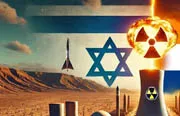
Israel's Nuclear Weapon Program
Israel is considered the sole nation in the Middle East that possesses nuclear weapons and is the only member of the United Nations that has not signed the Treaty on the Non-Proliferation of Nuclear Weapons.
Israel's first prime minister David Ben-Gurion was determined to obtain nuclear weapons to prevent the Holocaust from reoccurring. He stated, "What Einstein, Oppenheimer, and Teller, the three of them are Jews, made for the United States, could also be done by scientists in Israel, for their own people." Ben-Gurion decided to recruit Jewish scientists from abroad even before the end of the 1948 Arab–Israeli War that established Israel's independence.
Israel began to investigate nuclear-related science soon after it declared independence in 1948, and, with French cooperation, secretly began building the Negev Nuclear Research Center, a facility near Dimona housing a nuclear reactor and reprocessing plant in the late 1950s. Britain made secret shipments of restricted materials to Israel in the 1950s and 1960s. These included specialist chemicals for reprocessing and samples of fissile material—uranium-235 in 1959, and plutonium in 1966, as well as highly enriched lithium-6, which is used to boost fission bombs and fuel hydrogen bombs.
By 1967, it is believed that Israel had achieved an operational nuclear weapons capability, and mass production of nuclear warheads is thought to have commenced shortly after the Six-Day War.
Testing
Israel is suspected of conducting a covert nuclear test in 1979, associated with the Vela incident, in cooperation with South Africa's nuclear weapons program. An American Vela Hotel satellite designed to detect nuclear tests that contravened the Partial Nuclear Test Ban Treaty. As well as being able to detect gamma rays, X-rays, and neutrons, the satellite also contained two silicon solid-state bhangmeter sensors that could detect the unique dual light flashes associated with an atmospheric nuclear explosion: the initial brief, intense flash, followed by a second, longer flash. Further meteorological satellite, hydroacoustic, and radionuclide data support the event's identification as an atmospheric nuclear explosion.
Arsenal and Capabiliies
Estimates suggest that Israel's nuclear stockpile ranges between 90 and 400 weapons. It is believed that nuclear command and control decisions, including launch authorization must be jointly agreed by the Prime Minister and the Minister of Defense, and that Israel uses permissive action links to secure its warheads.
The status of Israel’s reported thermonuclear weapons, particularly regarding whether they are in the megaton range, remains unclear. Additionally, Israel is reported to have a variety of systems, including neutron bombs, tactical nuclear weapons, and portable nuclear devices. The production of its nuclear arsenal is believed to take place at the Negev Nuclear Research Center.
Israel's nuclear weapons delivery infrastructure encompasses several sophisticated systems designed to ensure strategic deterrence and second-strike capability. The Jericho 3 missile platform, characterized by an operational range spanning 4,800 to 6,500 kilometers, constitutes a primary component of this arsenal and is understood to provide reliable second-strike functionality.
Complementing this system, the road-mobile Jericho 2 intermediate-range ballistic missiles deliver regional coverage capabilities. To enhance survivability against potential nuclear contingencies, Israel's ballistic missile systems are reportedly positioned at substantial underground depths, affording protection from nuclear strike scenarios.
Israel maintains an offshore nuclear deterrent through submarine-based platforms, specifically employing submarine-launched nuclear-capable cruise missiles deployed from the Israeli Navy's Dolphin-class submarine fleet.
The Israeli Air Force augments these capabilities through its F-15I and F-16I Sufa fighter-bomber aircraft, which possess the capacity to deliver both tactical and strategic nuclear ordnance across extended distances via conformal fuel tank systems and sustained by an aerial refueling infrastructure comprising modified Boeing 707 tanker aircraft.
Israel possibly has several other nuclear weapons capabilities:
Suitcase bomb:
Israel developed the ability to miniaturize warheads small enough to fit in a suitcase by the year 1973
Tactical nuclear weapon:
Israel may also have 175 mm and 203 mm self-propelled artillery pieces, capable of firing nuclear shells
EMP strike capabilities:
Israel allegedly possesses several 1 megaton bombs, which give it a very large EMP attack ability
Enhanced Radiation Weapon (ERW):
Israel is also reported to have an unknown number of neutron bombs.
Nuclear land mine:
Israel supposedly has deployed multiple defensive nuclear land mines in the Golan Heights
|
|
|
|