|
India's Nuclear Weapon Program
The Indian nuclear weapons program was initiated in 1964, making it the seventh country to develop nuclear weapons. The 1962 Sino-Indian war underscored the need to have a strong military with a credible deterrent capability. The Chinese Nuclear Test at Lop Nur in 1964 goaded the Indian government into action to kickstart India's indigenous program to develop nuclear weapons. Initially, India's primary strategic concern was a conflict with China, while modern Indian policy focuses on potential conflict with Pakistan, which developed its own nuclear capability in 1983.
Preliminary studies were carried out at the Bhabha Atomic Research Centre and plans were developed to produce plutonium and other bomb components. The program was shelved after Prime Minister Jawahar Lal Nehru's death. It was revived in 1968 by Prime Minister Indira Gandhi.
India's first test was codenamed Smiling Buddha. The fully assembled device had a hexagonal cross section, 1.25 meter in diameter and weighed 1400 kg. The device was detonated at 02:34:55 UTC May 18 1974 in a shaft 107m under the army Pokhran test range in the Thar Desert, Rajasthan. Officially the yield was reported at 12kt, though outside estimates of the yield vary from 2kt to 20kt. The Indian government termed it a 'peaceful nuclear explosion'.
After Smiling Buddha India stopped testing temporarily. Successive governments in India decided to observe this temporary moratorium for fear of inviting international ire. In 1995, Prime Minister P.V. Narasimha Rao decided to carry out further tests. However the plans were halted after American satellites picked up signs of preparations for testing at Pokhran. The Americans under President Bill Clinton exerted enormous pressure on Rao to stop the preparations.
Operation Shakti
After the detection of the previous testing by American satellites in 1995, it was decided that preparations for the May 1998 Shakti test series should be undertaken under a blanket of total secrecy. Extensive planning was drawn up and executed in order to deceive intelligence agencies around the world. Even the senior most cabinet members of the Government of India did not have slightest hint of these elaborate preparations. The preparations were managed by a closed group of scientists, military officers and politicians.
A total of five nuclear weapons were detonated during the Pokhran-II (Operation Shakti) test series. They were:
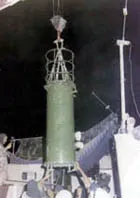
Shakti I
|
Shakti I
A two stage thermonuclear device with a boosted fission primary, its yield was downgraded from 200 KT (theoretical) to 40 KT for test purposes. The 200m deep shaft was designated "White House" or "Whisky".
Shakti II
A pure fission device using a plutonium implosion design with a yield of 15 KT. The device tested was an actual nuclear warhead that could be delivered by aircraft or mounted on a missile. The warhead was an improved, lightweight and miniaturized version of the device tested in 1974. Scientists at BARC had been working to improve the 1974 design for many years. The 150m deep shaft was called "Taj Mahal" or "Tango".
Shakti III
An experimental boosted fission device that used reactor grade plutonium for its primary with a yield of 0.3 KT. This test device was used to test only the primary stage. It did not contain any tritium required to boost the fission. This test was designed to study the possibility of using reactor grade plutonium in warheads and also to prove India's expertise in controlling and dampening a nuclear explosion in order to achieve a low (sub-kiloton) yield. The shaft was called "Kumbhkaran".
Shakti IV
A 0.5 KT experimental device. The test's only purpose was to collect data about the explosion process and to study the performance of various bomb components.
Shakti V
A 0.2 KT experimental device that used U-233, an isotope of uranium not found in nature and produced in India's fast breeder reactors that consume thorium. This devicewas also used to collect data.
The first three devices were detonated simultaneously at 10:16 UTC as measured by international seismic monitors. The measured seismic center of the triple event was located 2.8 km from the 1974 test site. The combined force of the three blasts lifted an area about the size of a cricket ground to a few metres above the earth kicking up dust and sand into the air. Two days later on 13 May at 6:51 UTC, the two sub-kiloton devices were detonated underground. This event was not detected by any seismic stations due to the low yield. With the five explosions, India declared the series of tests to be over.
India has a declared nuclear no-first-use policy and is in the process of developing a nuclear doctrine based on "credible minimum deterrence." In August 1999, the Indian government released a draft of the doctrine which asserts that nuclear weapons are solely for deterrence and that India will pursue a policy of "retaliation only". The document also maintains that India "will not be the first to initiate a nuclear first strike, but will respond with punitive retaliation should deterrence fail".
India is not a signatory to either the Nuclear Non-Proliferation Treaty (NPT) or the Comprehensive Test Ban Treaty (CTBT), but did accede to the Partial Test Ban Treaty in October 1963. India is a member of the International Atomic Energy Agency (IAEA), and four of its 17 nuclear reactors are subject to IAEA safeguards.
As of 2026, India possesses around 190 nuclear warheads. India has a full range of tactical and strategic nuclear weapon delivery systems including; nuclear-capable aircraft, ICBMs, short and medium range missiles, cruise missiles and nuclear powered and capable submarines.
|