 |
|
Home / Articles >
|
Davy Crockett - 1962 |Operation Sunbeam|
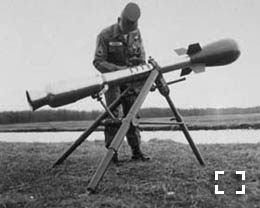
Loaded M-28 Launcher
|
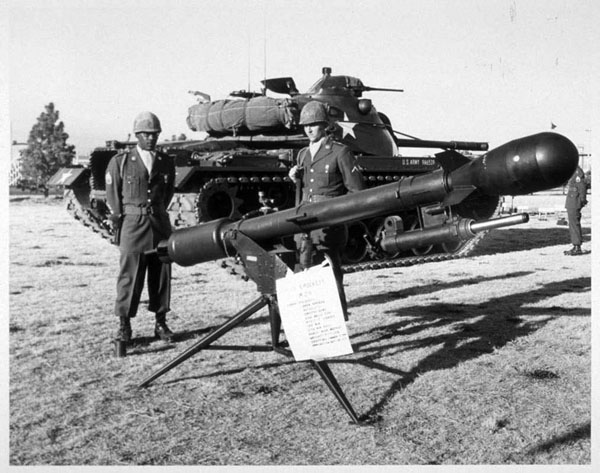
On 17 July 1962, a caravan of scientists, dignitaries and VIPs such as Attorney General Robert F. Kennedy gathered in Nevada to witness a historic event. They had come to observe the 'Little Feller I' test shot, the final phase of Operation Sunbeam (a.k.a. Dominic II). The main attraction was a secret device bolted to the roof of an armored personnel carrier, a contraption called the Davy Crockett. Named after the famous American folk hero, this defense apparatus was based on the tried-and-true recoilless rifle, a launcher similar to the shoulder-fired tubes used in the Second World War. Such weapons were designed to counteract much of their recoil by routing some expanding gas out the rear end, thereby producing forward thrust at the same moment that the projectile pushes the gun backward. However, the Davy Crockett Weapon System did improve on the concept in one important way: it paired this simple launch device with a tiny fission bomb, making it the most 'convenient' nuclear bomb delivery system ever developed.
As the threat of Soviet invasion loomed over Europe, US Army officials decided they needed a tool for halting or at least delaying the endless columns of troops and tanks that might one day pour out of East Germany and the USSR. The task fell to the Los Alamos Scientific Laboratory, where nuclear scientists succeeded in shoehorning an atomic bomb into an extremely small package. The W-54 warhead was then mated with a reliable delivery system, and the resulting weapons were handed over to the Atomic Battle Group for policing the border between East and West Germany.
The Atomic Battle Group was charged with the protection of Europe between 1961 and 1971, and during those ten years 2,100 of the Davy Crockett weapon systems were deployed. In the event of a Soviet invasion, these elite squads were trained to position themselves in the path of the advancing formations. Once in position, a flurry of mathematics would provide the trajectory and flight time to the targets, and this data would be used to configure the launchers for maximum carnage. A test shot with the integrated 37mm spotting gun would verify the operators' angle and timing calculations. The three men would then unpack a shell from its carrying case, set the timer knob to detonate the warhead roughly 6m above the target, and dial in their preferred yield of ten or twenty tons.
Deployment
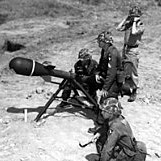 The M388 shell weighed about 35 kg, vaguely resembling a watermelon with fins. At thirty-one inches long and 79 cm in diameter, the projectile was too large to fit inside the gun, so it perched on the top while an attached rod was inserted into the barrel. The projectile could be fired from a 10 cm wide recoilless rifle which could hurl the weapon about two kilometres, or a larger 15 cm wide version which could heave it up to four kilometres. The launchers were mounted to jeeps and personnel carriers, and each was operated by a three-man atomic squad. The Davy Crockett was also designed to detach from its vehicle, allowing the teams to relocate on foot and dispatch their miniature mutually-assured-destruction from a handy tripod mount.
Upon receiving the order to fire, the projectile would leap from its perch with a bang and a cloud of smoke, racing through the sky in a long arc to intercept the advancing enemy. The rudimentary atomic bomb did not include an abort feature, so Davy Crockett was committed to destruction once it was en route. Even with the help of the spotter gun and rifled barrel, both of the M28 and M29 launcher designs were somewhat sloppy in their accuracy, so the detonation was likely to be several tens of metres from the target. Moreover, the warhead's relatively small yield didn't produce a great deal of blast damage even at the highest setting. However the weapon's tendency to spew radiation over the battlefield made up for its shortcomings as an explosive.
Effects
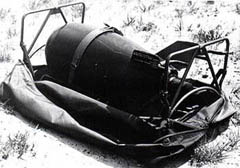
M388 warhead
|
Any person within a 400m radius of the explosion would face almost certain death. Those within the first 150m would be exposed to enough radiation to kill within minutes or hours, even with the protection of tank armor. People at about 300m from the blast would experience temporary fatigue and nausea which would then pass, but this misleading 'walking ghost' condition leads to a painful death after a few days of apparent well-being.
Those beyond a 400m would have better chances of survival, though many would require extensive medical care, and perhaps never fully recover from their injuries. Those lucky enough to be more than 550m from ground zero would be spared most of the harmful effects, but the mutations in their DNA would give them an increased risk of cancer later in life.
The Davy Crockett's timer allowed a minimum shot distance of about 300m, but such inept use of the weapon would certainly result in the deaths of the firing team. In most cases, the approaching enemy would be at least a couple of kilometres away, leaving the Atomic Battle Group personnel outside of the hazard zone. Even if the launcher's lack of accuracy resulted in relatively few enemy casualties, the radioactivity from these tiny fission bombs could be used for 'area denial' tactics. Effectively rendering large areas of the battlefield uninhabitable for at least 48 hours, allowing time for American and NATO forces to mobilize.
Variants
There was a practice round called the M390 which was outwardly similar to the nuclear armed round, designed to be a ballistic match. It contained 7.3 kg of Composition B high explosive that was detonated by an electrical switch on impact with the ground. The practice round had a significant destructive effect in its own right and was intended to be used in combat in an emergency situation. A further type of dummy training round the M421, was completely inert and was intended to be used for training purposes.
Variations of the W-54 warhead found a few other niches during the Cold War, including the Special Atomic Demolition Munition (SADM) which could be simply dropped off at a target and set to explode with a timer. A more powerful 250 ton variant was also used on the AIM-26 Falcon, a guided air-to-air missile. Fortunately these ultra-portable casualty dispensers were never used outside of the Nevada desert.
In addition to being the smallest nuclear device ever developed by the United States, the Davy Crockett also has the distinction of being the last atomic device tested by the US in the open atmosphere. The 1962 test shot at the Nevada Proving Grounds confirmed the effectiveness of the design, and the device's tiny form factor made it fast and easy to deploy on the battlefield.
With the destructive power of twenty tons of TNT squeezed into a watermelon-sized package, it's hard to outperform the Davy Crockett in terms of convenient annihilation. However amid concerns of the unauthorized use of tactical 'battlefield' weapons by overzealous commanders far down the chain of command, the Davy Crockett represented a real risk of triggering a major nuclear exchange.
|

| - DNA 3027F - Defense Nuclear Agency report - Dominic II - Little Feller II, Johnnie Boy, Small Boy, little Feller I
|
|
|
|